
A walking tour down to the canals
From Chetham's Library to the Roman fort, via cotton money, a round reading room, and Peterloo. About two hours if you keep moving.
Loading map…
This is the long way down the city, from the oldest public library to the fort the place is named after. Give it two hours if you stay outside. Give it the afternoon if Chetham’s or Rylands let you through the door.
The old bit is compact, which is a mercy. Chetham’s sits in a 15th-century college and has been a public library since 1653, still quietly proud of being the oldest in the English-speaking world. The alcove where Marx and Engels worked in the summer of 1845 is still pointed out, and it is a better story than most plaques. The cathedral next door is mostly 15th century, battered in the Blitz and pieced back together, and it only became a cathedral in 1847. The Old Wellington, around the corner, is a 16th-century merchant’s house that the city has physically relocated twice: once to make room for the Arndale, again after the 1996 bomb. It now sells beer beside the cathedral, which feels like Manchester being honest about its priorities.
The squares are the money. From the cathedral you drop into St Ann’s Square, where the Royal Exchange finished its Great Hall in 1921 for the cotton trade. People had been buying and selling thread on this site for a century before that. The theatre now hangs in the room. St Ann’s Church was consecrated in 1712, a Georgian building with the shopping grown up around the churchyard. Keep going south to Albert Square. Alfred Waterhouse’s town hall opened in 1877, and a long restoration has made the inside a question you should check on the day. The clock tower is the promise you can keep.
St Peter’s Square is the round library, Vincent Harris’s, opened in 1934. Go in for the reading room, then step off the square to the Peterloo memorial. On 16 August 1819 cavalry charged a crowd gathered to hear Henry Hunt argue for the vote. Eighteen people were killed. The rings are Jeremy Deller’s, from 2019. The field itself is the square and the streets you are already standing on. Take Peter Street west past the Midland, the railway hotel of 1903, where Charles Rolls and Henry Royce met in the lobby the following year and decided to build a car.
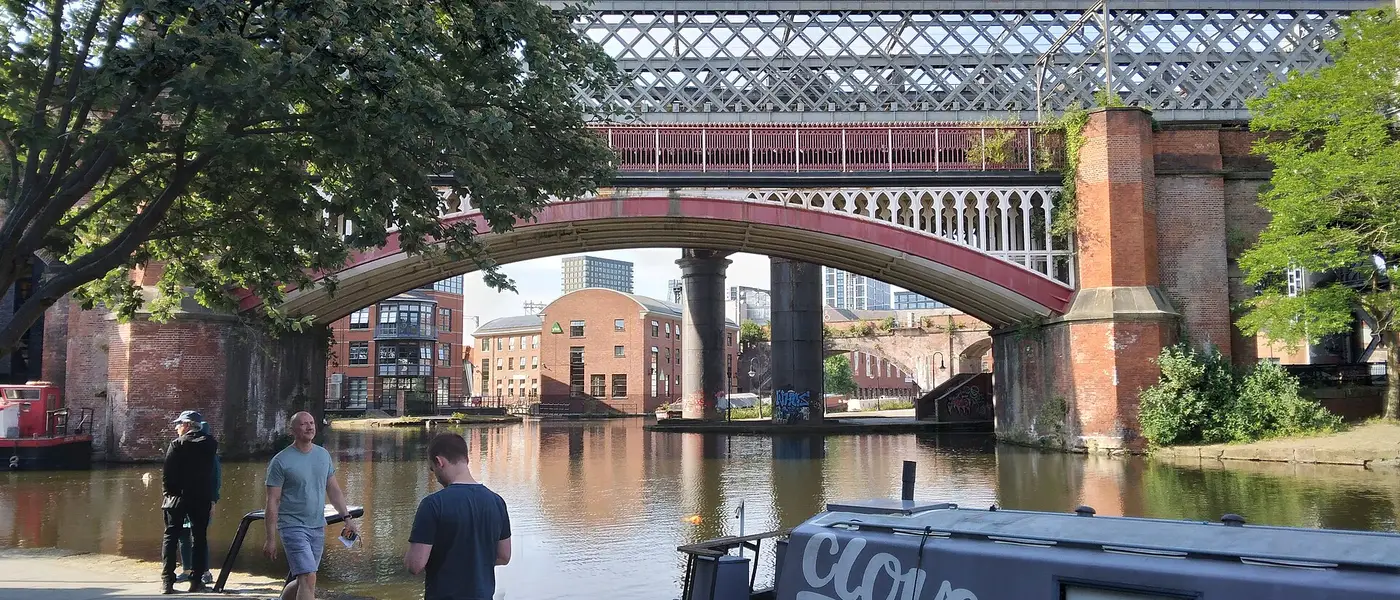
Then Deansgate, and the tone changes. John Rylands Library was Enriqueta Rylands’ memorial to her husband. Basil Champneys designed it, and it opened to the public on the first day of 1900. The entrance hall does what she wanted it to do. Liverpool Road station opened with the Liverpool and Manchester Railway on 15 September 1830 and is still the oldest surviving passenger railway station. It lives inside the Science and Industry Museum, so the main galleries are there if the platform isn’t enough. Castlefield is the end of the walk. Mamucium, the Roman fort of about AD 79, is the name Manchester wore down into something you can shout in a pub. The timber gate is a reconstruction, there so you can see the scale. The ditches are the old part.
Some doors keep their own hours: Chetham’s, Rylands, the museum, and especially the town hall. The landmarks map holds the places this route leaves out on purpose, including Pankhurst’s house, Gaskell on Plymouth Grove, Victoria Baths, the Jewish Museum, Turing’s bench, the Ancoats mills, Gorton Monastery, Lincoln, Engels, and the People’s History Museum. A few of those are the better rooms. This one is the walk you can finish in a pair of shoes.
If your head is still in last night, the bar crawl ends where this walk ends. That was the idea.