
The Tall Hats of Newton Heath
Culcheth Military Band’s own website went dark years ago. The Wayback Machine still holds their history — from Derbyshire mill hands to Whit Monday toppers.
For years, if you wanted the story of Culcheth Military Band, you went to culchethmilitaryband.co.uk. The site is gone now. The band’s own pages survive in the Internet Archive — a local history that would otherwise have followed the domain into the dark.
They were Newton Heath’s Tall Hats. Not Culcheth in Cheshire; Culcheth the old Manchester township, hard against Newton Heath, where a Sunday school and a brass band grew up together.
From Curbar to Culcheth
The account the band kept online was compiled in the mid-1920s by secretary J.T. Ogden, with help from founders Thomas Goddard and Charles E. Swindell. In 1868 Goddard left Curbar in Derbyshire for work at Swift’s Mill, Daisy Bank. He knew brass from home — his father had played trombone in the Baslow Band — and he fell in with other Derbyshire men already living here: John Sellars, a bootmaker on Droylsden Road, and John Swindell among them.
They bought second-hand instruments from Miles Platting on the weekly, borrowed an ophicleide and trombone from Stoney Middleton, and rehearsed in Sellars’ parlour. The ophicleide was christened “Sixteen String Jack.” One night in Lily Lane, Moston, they tried playing outdoors and the neighbourhood decided they were laying a suicide’s ghost. By early 1873 the parlour was too small; they moved to the Ragged School and marched circles indoors until someone attempted the street — Men of Harlech, no agreed knock-off, most of them collapsing from exhaustion on the way back.
Their first public job was the foundation stone of a Primitive Methodist church in Newton Heath that summer. Then membership thinned. Three players who belonged to Culcheth Sunday School arranged a takeover. In 1873 the instruments were bought with loans from the school’s Sick and Burial Society and Penny Bank, and the band was remade as the Culcheth Sunday School Temperance Brass Band. That is the line that became Culcheth Military Band.
Why Tall Hats
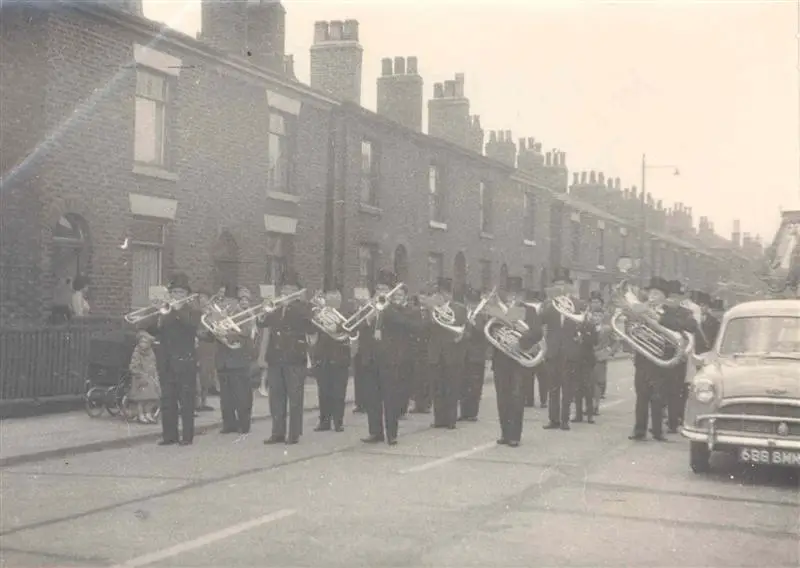
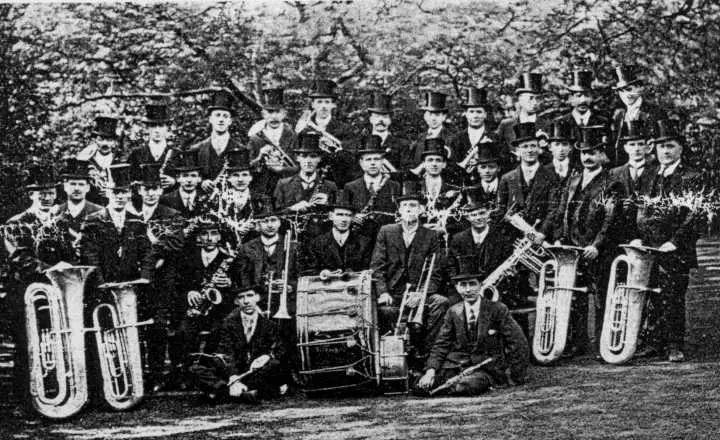
They needed a uniform for Whit Friday at Stalybridge around 1875. Money was short. Someone suggested tall hats and white waistcoats — gentlemanly, and you could beg or borrow them. Linings were torn out, packing stuffed in, waistcoats gusseted at the back. The crowd noticed the look, not the alterations. The white waistcoats went; the toppers stayed. By 1913 the Manchester City News, marking the silk hat’s centenary, was still pointing them out on Whit Monday as the Tall Hat Band — better known by the nickname than by Culcheth.
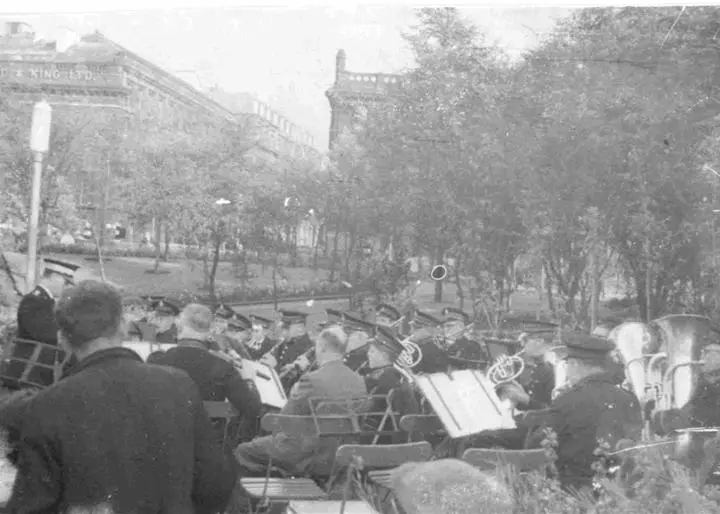
That Whit Monday engagement with St Philip’s, Bradford Road, settled into an annual fixture. They opened Blackpool’s lakeside bandstand when it was new in 1929. In 1886 they added woodwind and became a reed band. Through Jubilees, Town Hall openings, park concerts, and two world wars — nearly the whole membership away in 1914–18, all of them back afterwards — the Tall Hats stayed a Newton Heath habit.
Composer Arthur Butterworth, later of Besses o’ th’ Barn and the Hallé, passed through as a young player. Generations did.
After the website
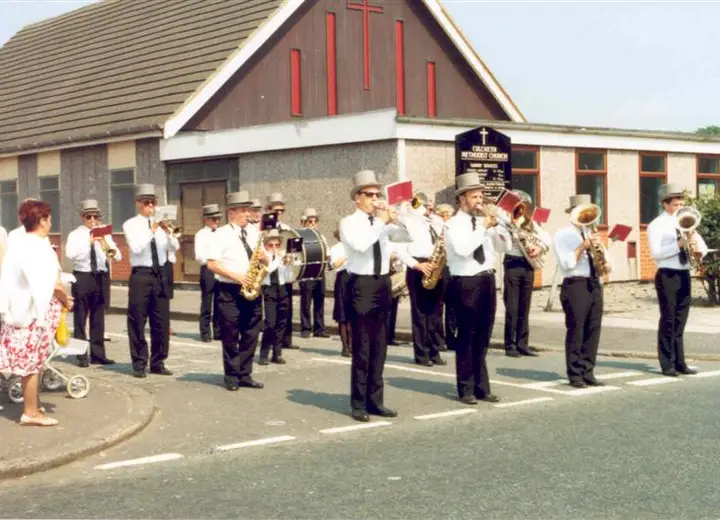
In January 2013 the Manchester Evening News reported that Culcheth Methodist Church on Droylsden Road was closing, and the band that had practised there since 1873 had a month to find somewhere else. Conductor Michael Donnelly, who had joined in 1955 at fifteen because his father was already in it, said Newton Heath without the Tall Hats was unthinkable. The church building itself was a 1972 replacement of an older one; the continuity was the band, not the brickwork.
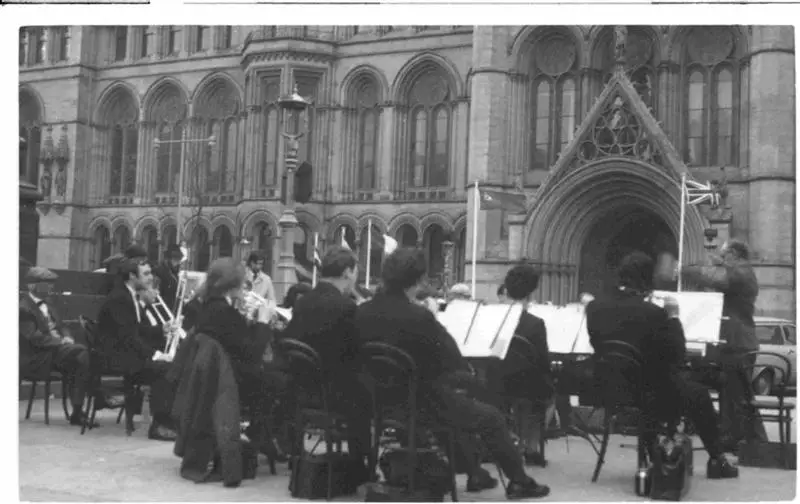
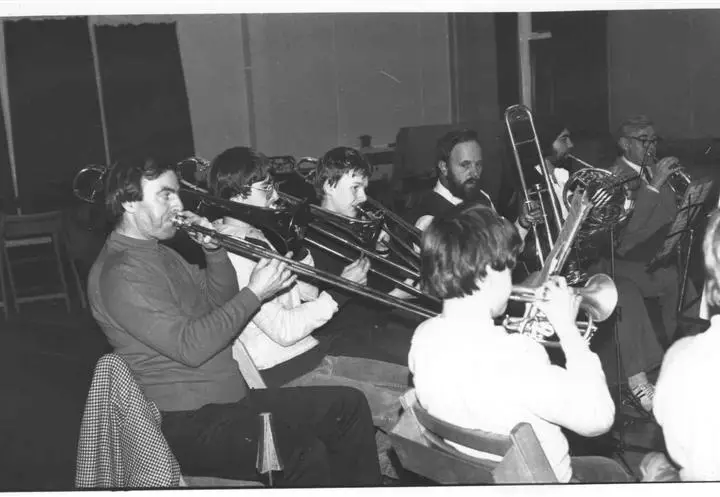
By the time Andy Booth’s site was last usefully captured, rehearsals had moved — Tuesdays, 7:30 to 9:30, at Albion United Reformed Church in Ashton-under-Lyne. The photo gallery on that site is where these frames come from.
From the archive
A few frames pulled back from the old site. The Droylsden Road march is the one that makes the nickname obvious.
Websites die quietly. The recovery is less glamorous than a museum case, but it does the same job — keep the names, the instruments, and the reason a Newton Heath crowd once looked for silk hats on Whit Monday. The long history page is still readable on the Wayback Machine; this is the short version for anyone who would never have known to look.